4g Radios-How they work
4G Walkie Talkies UK – How They Work
A straightforward guide to Push-to-Talk over Cellular (PoC) technology.
What is a 4G Walkie Talkie?
A 4G walkie talkie (often referred to as a PoC or Push-to-Talk over Cellular device) combines the instant one-touch communication of a traditional two-way radio with the reach and infrastructure of modern mobile phone networks.
Instead of broadcasting standard radio waves directly from device to device, a 4G walkie talkie converts your voice into digital data packets and transmits them over mobile data networks to servers, which instantaneously route the audio to your talkgroup anywhere in the country.
How Far Does It Work?
Virtually unlimited range.
Because these radios rely on cellular infrastructure rather than direct line-of-sight radio signals, distance is no longer a restriction. As long as the device is within range of a 4G mobile tower or connected to a local Wi-Fi network, it will work.
- Talk from London to Edinburgh as clearly as if you were in the same room.
- Communicate seamlessly between indoor offices, moving vehicles, and outdoor field sites.
- International communication, also providing the Sim providers have a roaming agreement with that trerritory.
How It Differs From a Normal Walkie Talkie
Traditional two-way radios (such as PMR446 license-free or licensed VHF/UHF radios) and 4G devices serve similar purpose-built instant communication needs, but operate under completely different mechanics:
| Feature | Standard Walkie Talkie | 4G Walkie Talkie |
|---|---|---|
| Range | 1–5 miles (limited by terrain & buildings) | Nationwide / Global |
| Signal Path | Direct RF (Radio Frequency) unit-to-unit | Mobile networks & internet servers |
| Obstacles | Thick walls & hills block signal easily | Works anywhere cellular or Wi-Fi reaches |
| Infrastructure | Requires repeaters for long distances | Uses existing mobile phone masts |
| Features | Basic voice transmission | crystal clear digital quality |
SIM Cards and Wi-Fi Connectivity
To operate, a 4G walkie talkie requires an active data pathway. This is handled in two ways:
1. Multi-Network SIM Cards
Most commercial 4G radios in the UK use dedicated unsteered multi-network SIMs. Rather than being tied to just one provider (e.g., EE, Vodafone, O2, or Three), these SIM cards automatically latch onto whichever mobile network offers the strongest signal in that precise location, minimizing dead zones. We supply complimentary sims with all of our devices.
2. Built-in Wi-Fi Integration
When working inside steel-structured warehouses, basements, or rural facilities where cellular signal might drop, some radio models have wi-fi capability to connect to local Wi-Fi networks. This ensures continuous, uninterrupted Push-to-Talk coverage indoors.
Nationwide Coverage & The Importance of Band 20
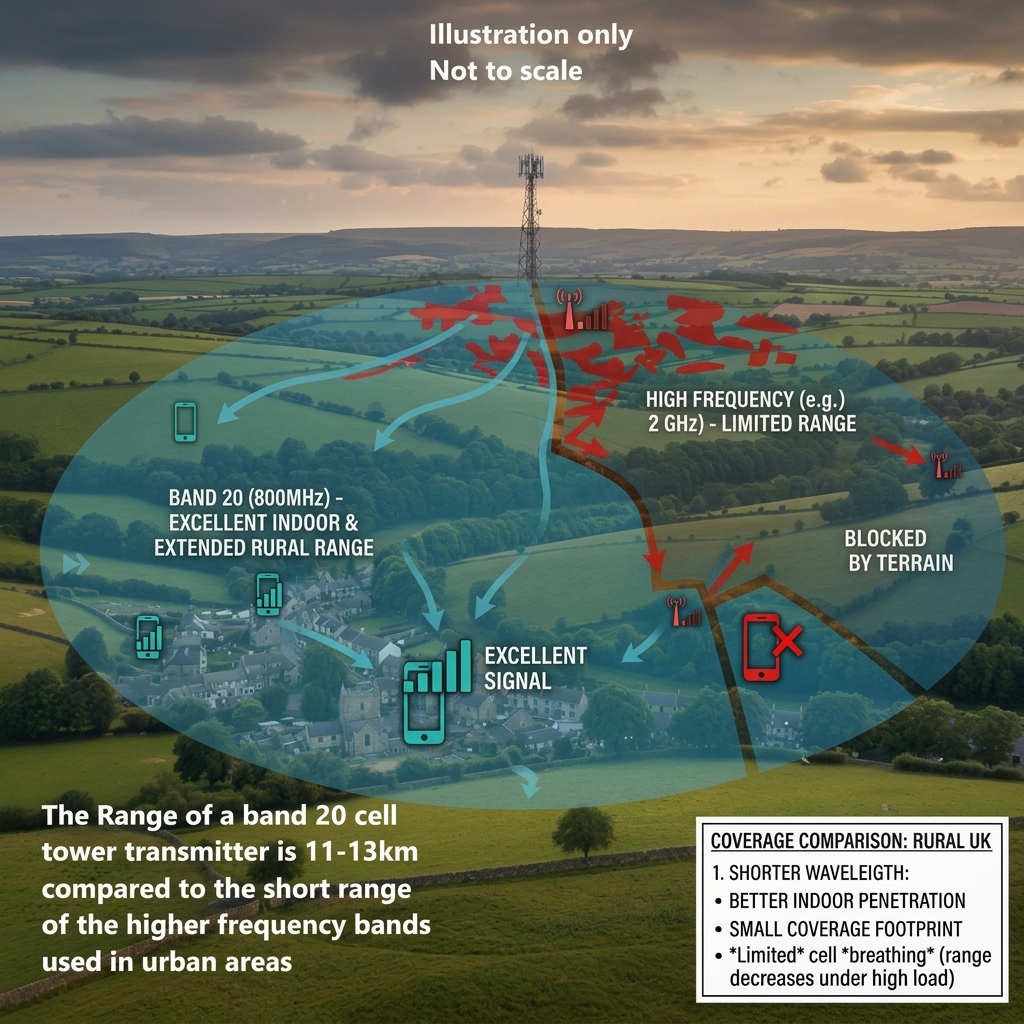
The UK offers over 99% outdoor population coverage on 4G, making nationwide walkie talkie deployment extremely reliable. However, regional terrain and building penetration pose challenges—which is where LTE Band 20 comes in.
Why Band 20 (800 MHz) Matters in the UK
Band 20 operates on the 800 MHz frequency spectrum. In radio physics, lower frequencies travel further and penetrate solid obstacles much better than higher frequencies.
- Rural Range: Band 20 radio waves cover vast geographical distances, making it critical for rural UK connectivity.
- Indoor Penetration: It easily passes through thick brick, stone, and steel structure walls.
When selecting a 4G walkie talkie for UK deployment, ensuring the hardware supports Band 20 (800 MHz) is crucial for ensuring reliable coverage across remote areas and inside complex buildings.